

Fluid intelligence (Gf) is your capacity to reason through novel problems without relying on prior knowledge. Crystallized intelligence (Gc) is the accumulated fund of facts, vocabulary, and skills you have built through experience. The core lifecycle pattern is straightforward: Gf tends to peak earlier in adulthood and gradually softens afterward, while Gc typically keeps rising into your 60s and holds steady well beyond that.
Neither ability outranks the other. A brilliant strategist with no domain knowledge stalls just as easily as an encyclopedic expert who cannot adapt to a new problem. Both systems work together constantly, and understanding where you stand on each one tells you more about your cognitive profile than a single IQ number ever could.
- Fluid intelligence (Gf): reasoning, pattern recognition, and problem solving in unfamiliar situations
- Crystallized intelligence (Gc): stored knowledge, vocabulary, and learned procedures
- Age pattern: Gf rises then declines starting in early-to-mid adulthood; Gc accumulates for decades
- Practical takeaway: the rest of this guide breaks down how each is measured, how they interact, and how you can check your own balance between them
Key Takeaways
Fluid intelligence peaks earlier and declines gradually while crystallized intelligence accumulates for decades, and the gap between your two scores reveals more than any single IQ number.
| Point | Details |
|---|---|
| Two distinct systems | Fluid intelligence handles novel reasoning; crystallized intelligence stores accumulated knowledge and vocabulary. |
| Different age trajectories | Gf typically peaks in your 20s to 40s while Gc often keeps rising into your 60s or 70s. |
| Both operate together | Real tasks like exams, new software, and clinical decisions draw on fluid strategy and crystallized knowledge at once. |
| Training has real limits | Working memory drills show narrow gains that rarely transfer broadly to fluid reasoning. |
| Measure your own profile | Wisdomiq's domain-level IQ test breaks results into pattern recognition, math, verbal reasoning, and spatial thinking to reveal your Gf/Gc balance. |
Table of Contents
- Fluid vs Crystallized Intelligence: Origins and Brain Basis
- How Fluid Vs Crystallized Intelligence Gets Measured
- Fluid Vs Crystallized Intelligence Across the Lifespan
- Real-World Examples of Fluid and Crystallized Intelligence
- Can Fluid and Crystallized Intelligence Change?
- Checking Your Own Fluid Vs Crystallized Profile
- What Your Gf/Gc Profile Means for Study and Career Choices
- Do Fluid and Crystallized Intelligence Differ Across Groups?
- Common Myths About Fluid and Crystallized Intelligence
- Why Understanding Both Systems Changes How You Plan
- Get Your Own Fluid Vs Crystallized Breakdown
- Sources
Fluid vs Crystallized Intelligence: Origins and Brain Basis
Psychologists Raymond Cattell and John Horn built the Gf/Gc framework because a single "g factor" score couldn't explain why people's cognitive abilities age so differently. Cattell first proposed the split in the 1940s, and Horn expanded it into a formal model that became one of the most durable frameworks in psychometric theory. The insight was simple but overlooked at the time: intelligence isn't one thing that rises and falls together. It's at least two systems moving on different clocks.
Fluid intelligence is defined as the capacity to reason, spot patterns, and solve unfamiliar problems independent of prior knowledge. It shows up when you're handed a puzzle you've never seen and have to figure out the rule from scratch. Crystallized intelligence is the opposite kind of ability: facts, vocabulary, and procedural skill gained through experience and cultural learning. It shows up when you answer a trivia question or apply a formula you memorized years ago.
The task examples make the distinction concrete:
- Gf tasks: solving a logic puzzle, figuring out an unfamiliar app's interface, diagnosing a pattern in unfamiliar data
- Gc tasks: defining a word, recalling a historical date, applying a well-practiced accounting rule
- Mixed tasks: most real jobs and exams, which draw on both systems at once
Fluid intelligence recruits the lateral prefrontal cortex and the parietal cortex most heavily, the regions tied to working memory and abstract manipulation. Crystallized intelligence draws more on temporal lobe structures and distributed cortical networks built up through years of learning and retrieval. That difference in brain architecture is part of why the two abilities age on different schedules. The circuits supporting rapid, novel reasoning are more vulnerable to the effects of time than the broadly distributed networks storing lifelong knowledge.
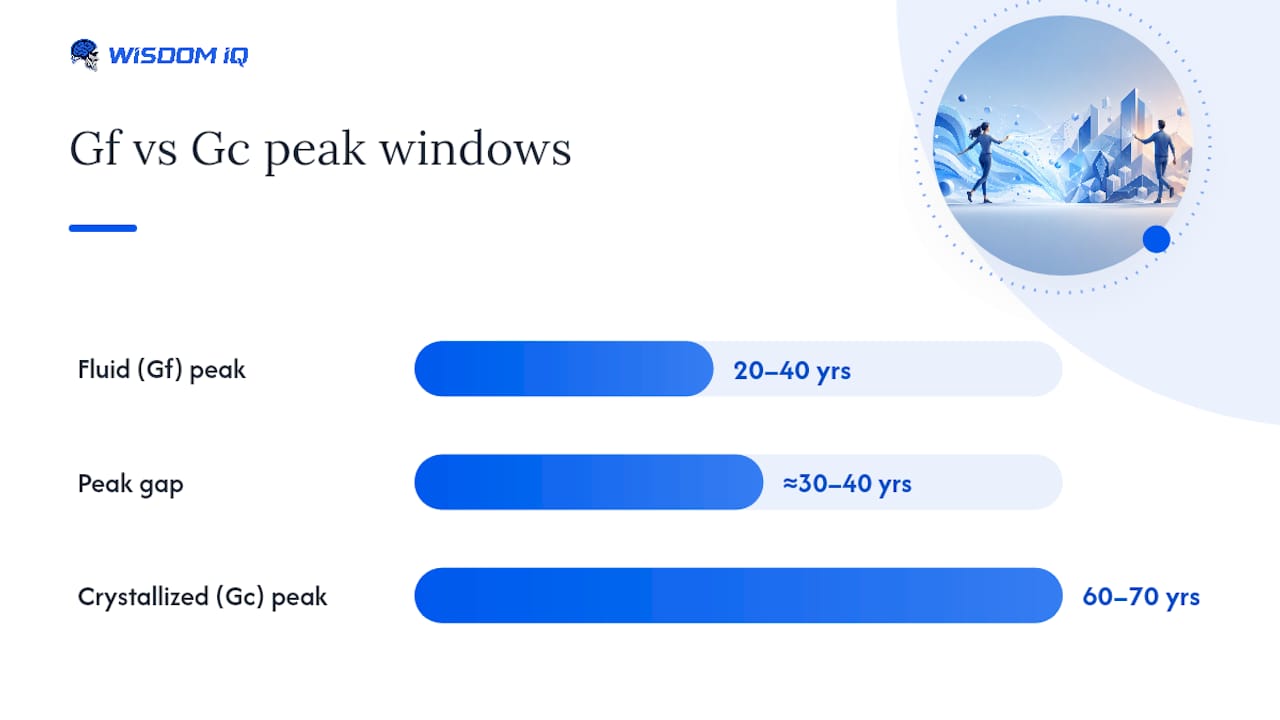
Statistic callout: Verywell Mind's synthesis of the lifespan research puts Gf's peak window roughly between the 20s and 40s, while Gc often climbs until around age 60 to 70 before declining only gradually. That 30 to 40 year gap between the two peaks is the single most important fact in this entire topic.
How Fluid Vs Crystallized Intelligence Gets Measured
You can't see fluid or crystallized intelligence directly. Psychologists infer them from performance on specific tasks designed to isolate each system, and knowing what those tasks look like helps you interpret your own test results with real precision.
- Raven's Progressive Matrices. This is the classic Gf instrument: a sequence of abstract geometric patterns with one piece missing, and you pick the shape that completes the logic. There's no vocabulary, no cultural reference, no formula to remember. It's pure pattern extraction under time pressure.
- Working memory and speeded reasoning tasks. Digit span tests, n-back tasks, and timed logic puzzles all load heavily on fluid ability because they demand you hold and manipulate new information on the spot.
- Vocabulary and information subtests. These are the standard Gc measures. You're asked to define words or answer general knowledge questions, tasks that reward what you've already learned rather than what you can figure out live.
- Full-scale IQ composites. Most standardized IQ tests blend Gf and Gc subtests into a single score. That's efficient for a headline number but it can mask a lopsided profile. Someone scoring well on the composite might be carrying a strong crystallized score while their fluid reasoning lags, or vice versa.
Reading a subtest breakdown is where the real information lives. If your abstract-reasoning subtests sit noticeably higher than your vocabulary and information subtests, you're looking at a fluid-dominant profile: quick on novel problems, with more room to build stored knowledge. The reverse pattern, strong domain knowledge with slower live problem-solving, points to a Gc-dominant profile. Neither pattern is a deficit. They're just different starting points for how you'd approach learning or career decisions.
Pro Tip: Don't judge your cognitive profile from a single composite score. Ask for the domain-level breakdown whenever you take an assessment, and compare your pattern-recognition results against your verbal and knowledge results side by side.
Cultural and educational bias is the honest caveat here. Crystallized intelligence tests are, by design, sensitive to what you were taught and what language you grew up speaking. A vocabulary test built around one culture's idioms will systematically underrate someone from a different linguistic background, regardless of their actual reasoning ability. Fluid intelligence tests were built to dodge this problem by relying on abstract shapes instead of words, but even Raven's Matrices show some sensitivity to test familiarity and educational exposure to pattern-based problem formats. No test is a perfectly neutral instrument, and any responsible read of your results should factor that in.
Fluid Vs Crystallized Intelligence Across the Lifespan
The clearest finding in this entire field is the divergence in age trajectories, and it's worth sitting with because it overturns a common assumption that intelligence simply declines as one package after some peak age.
Fluid intelligence tends to peak in a window roughly spanning the 20s to 40s, then eases into a gradual decline. Crystallized intelligence moves in nearly the opposite direction. It climbs steadily through most of adulthood and often peaks around age 60 to 70, holding largely stable even after that. Think of Gf as a sprinter's ability and Gc as a library that keeps expanding for decades after the sprinter has slowed down.
- Gf peak window: roughly 20s through 40s, with gradual softening afterward
- Gc peak window: often 60s to 70s, with only slow decline past that point
- Individual variation is large: the ranges above are typical patterns, not fixed rules
- Disease-driven decline (dementia, certain neurological conditions) looks different from normal aging and tends to affect both systems more sharply and unevenly
That last point matters more than it might seem. Normal aging chips gradually at fluid reasoning speed while crystallized knowledge stays largely intact or even grows. Pathological decline, by contrast, often erodes both systems together and disrupts the very knowledge structures that would otherwise compensate. That's part of why a sudden drop in someone's vocabulary or general knowledge, not just their processing speed, is treated as a more serious warning sign in clinical settings than the usual slow fluid-reasoning slide.
Statistic callout: the Gf decline curve is not a cliff. Reviews of longitudinal cognitive data point to real heterogeneity, and continued cognitive engagement is associated with better-preserved fluid reasoning even into later decades. People whose work or hobbies keep demanding novel problem solving hold onto sharper fluid scores than peers of the same age who stopped challenging themselves. Age sets the general trend; behavior nudges where you land inside it.

Real-World Examples of Fluid and Crystallized Intelligence
Watching Gf and Gc operate side by side in everyday tasks makes the abstract definitions click. Almost nothing you do at work or in school draws on just one system in isolation.
- Learning new software: figuring out an unfamiliar interface from scratch draws on Gf; remembering keyboard shortcuts from a program you used for years draws on Gc.
- Taking an exam: working through a novel word problem calls on fluid reasoning; recalling the formula needed to solve it calls on crystallized knowledge.
- Clinical decision-making: a doctor facing an atypical case has to reason through the anomaly (Gf) while drawing on years of accumulated medical knowledge (Gc) to know what's even possible.
- Cooking a new recipe: adapting to a missing ingredient on the fly is fluid problem-solving; knowing which substitutions work at all comes from crystallized culinary knowledge.
Math problems illustrate the partnership especially well. Fluid intelligence supplies the strategy, recognizing what kind of problem you're looking at and how to approach it, while crystallized intelligence supplies the formulas and procedures needed to actually execute that strategy. Neither one gets you to the answer alone.
There's also a compounding relationship worth noticing: strong fluid reasoning early in life tends to accelerate how much crystallized knowledge you accumulate later. Someone who reasons quickly through new material tends to absorb and retain more of it, which means high Gf in your 20s often shows up decades later as an unusually deep and well-organized Gc. This is one reason career experts who look sharp and knowledgeable in their 50s frequently trace that edge back to strong early reasoning ability, not just years on the job. Experience matters, but experience processed through strong reasoning compounds faster.
Can Fluid and Crystallized Intelligence Change?
Crystallized intelligence is the more obviously malleable of the two. Education, deliberate practice, and sustained curiosity build it directly, and there's no real controversy here: read more, study more, work in a field long enough, and your stored knowledge grows. Structured learning is the primary engine for building crystallized ability at any age, which is genuinely good news if you feel your Gc score has room to grow. It almost always does.
Fluid intelligence is a tougher question, and this is where a lot of commercial "brain training" marketing overstates the evidence. Controlled studies on targeted cognitive training, working memory drills in particular, do show measurable gains on the specific trained task. The problem is transfer. Those gains often fail to generalize to broader fluid reasoning or to real-world outcomes, which means getting better at one app's memory game doesn't reliably make you a sharper problem solver outside that app.
What does show more consistent, if associative rather than causal, evidence:
- Regular physical exercise, associated with better-preserved processing speed and reasoning in aging populations
- Consistent, adequate sleep, tied to working memory and attentional control
- Exposure to novel and cognitively demanding activities rather than repetitive, familiar tasks
- Sustained social and intellectual engagement across the lifespan
None of these are guaranteed fixes, and the research here is associative, not proof of a guaranteed causal lever you can pull. But the pattern is consistent enough across studies that it's a reasonable bet for anyone who wants to protect their fluid reasoning as they age.
Pro Tip: If you're evaluating a "brain training" app's claims, ask whether it reports transfer to untrained tasks, not just improvement on its own exercises. Improvement on the app's internal game is nearly meaningless on its own.
Checking Your Own Fluid Vs Crystallized Profile
Getting a personal read on your own Gf/Gc balance doesn't require a research lab. It requires a test that actually separates the two constructs instead of blending everything into one number, and then knowing how to read what comes back.
Compare your subtest results directly: pattern recognition and spatial reasoning scores map onto fluid ability, while verbal reasoning and general knowledge scores map onto crystallized ability. A gap between the two tells you something real. Higher Gf with lower Gc suggests fast, adaptable problem solving with room to deepen stored knowledge through reading and study. Higher Gc with lower Gf suggests deep domain expertise paired with slower live reasoning under novel conditions, often a completely normal pattern for someone further along in their career.
Wisdomiq's online IQ test is built around exactly this kind of domain-separated reporting. It assesses four domains, pattern recognition, math, verbal reasoning, and spatial thinking, across 20 precision questions, and returns a breakdown by domain rather than a single opaque number. That structure maps cleanly onto the Gf/Gc distinction: pattern recognition and spatial thinking lean fluid, while verbal reasoning leans crystallized, with math sitting at the intersection of both. Results come with percentile ranks and an official certificate, and every score is encrypted and stored privately.
- Take a validated test that reports domain-level results, not just a composite score
- Compare your pattern-recognition and spatial scores against your verbal and knowledge scores
- Build a learning plan around the gap: targeted practice for a lagging domain, deliberate reading and study for building Gc
- If you notice a sudden, sharp drop in either domain compared to past performance, that's worth raising with a doctor rather than assuming it's ordinary aging
Statistic callout: validated assessments that report pattern recognition, verbal knowledge, and spatial reasoning separately give a far more actionable profile than a single IQ figure, because they show you exactly where to direct practice instead of leaving you guessing.
What Your Gf/Gc Profile Means for Study and Career Choices
Your dominant profile should shape how you study, not just how you feel about your results. If you lean fluid, problem-solving practice, timed puzzles, unfamiliar case studies, novel scenarios, sharpens the ability you already lean on. If you lean crystallized, systematic study methods like spaced repetition and structured reading build the knowledge base that's your natural strength.
Career fit follows the same logic. Roles built around live troubleshooting, R&D, emergency response, early-stage strategy, tend to reward strong fluid reasoning. Roles built around accumulated expertise, law, medicine, senior technical leadership, reward deep crystallized knowledge, which is part of why so many fields see performance improve well into a person's 50s and 60s rather than decline.
- Fluid-leaning learners: prioritize novel problem sets and timed practice over rote review
- Crystallized-leaning learners: prioritize structured study, spaced repetition, and broad reading
- Career timing: fields rewarding accumulated expertise often see peak performance later in a career, not earlier
- Aging well: lean on your growing crystallized knowledge to compensate for any fluid slowdown, while staying engaged in novel, challenging activities to protect what fluid reasoning you have
Do Fluid and Crystallized Intelligence Differ Across Groups?
Group-level differences in Gf and Gc show up mostly as differences in test content exposure, not fixed differences in underlying ability. Crystallized intelligence tests are inherently tied to language and cultural background, so a vocabulary test built around one culture's references will understate the crystallized ability of someone raised in a different linguistic environment, even when their actual knowledge base is just as deep in their own context.
Fluid intelligence tests were designed to sidestep this by relying on abstract, nonverbal patterns rather than language or cultural content. That design goal mostly works, but it isn't airtight. Familiarity with standardized testing formats, timed conditions, and abstract-pattern problems still shapes performance to some degree, which means educational background leaves a fingerprint on fluid scores too, just a lighter one than on crystallized scores.
Gender comparisons in the research show far more overlap than difference at the population level. Where small average gaps appear on specific subtests, they tend to reflect differences in item content, familiarity, or socialization patterns rather than a fundamental gap in the two underlying constructs. The far bigger driver of variation in both Gf and Gc, across every demographic group studied, is individual variation: education, occupation, health, and how consistently a person keeps challenging their reasoning and expanding their knowledge base. Group averages tell you far less than an individual's actual test profile.
Common Myths About Fluid and Crystallized Intelligence
The most persistent myth is that intelligence is one fixed number that simply goes downhill after some peak age. That framing collapses the moment you separate Gf from Gc, since one system is climbing while the other is easing off, often for decades at the same time.
A second myth: that fluid decline means someone becomes generally less capable. It usually means they're slower or less flexible on genuinely novel problems, while their crystallized knowledge, built over a lifetime, often lets them route around that slowdown entirely by drawing on experience instead of raw improvisation.
A third myth, heavily pushed by some brain-training marketing, is that daily puzzle games measurably raise your general intelligence. The evidence doesn't support that leap. Training gains tend to stay narrow to the trained task rather than lifting fluid reasoning broadly.
A fourth myth is that crystallized intelligence is somehow the "lesser" or passive form of intelligence, mere memorization rather than real thinking. That undersells it badly. Deep domain knowledge is what lets experienced professionals spot patterns novices miss entirely, often faster than a fluid-reasoning approach could work the problem from scratch.
And a fifth: that IQ tests measure a single, unified thing. Most composite scores blend Gf and Gc together, which is exactly why a domain-level breakdown tells you so much more than one headline number ever could.
Why Understanding Both Systems Changes How You Plan
The gap most people miss isn't between fluid and crystallized intelligence. It's between knowing this distinction exists and actually using it to make decisions. Plenty of readers can recite that Gf peaks early and Gc peaks late, then go right on treating a single IQ score as the full picture of their cognitive standing.
What the evidence actually supports is more useful and more specific: your fluid and crystallized scores tell two different stories, and the gap between them is diagnostic. A fluid-dominant profile in your 20s is a strong argument for leaning into fast-moving, novel-problem-heavy work while that edge is sharpest, and for building crystallized knowledge deliberately now so it compounds for decades. A crystallized-heavy profile later in a career isn't a sign of decline. It's the payoff of years spent processing information through what was, at the time, a fluid reasoning advantage.
The brain-training industry has done readers a disservice by implying fluid intelligence is a muscle you can isolate and grow with the right app. The honest evidence points somewhere less flashy but more actionable: protect fluid reasoning through genuine novelty and physical health, and build crystallized knowledge through the unglamorous work of reading, study, and sustained practice. Measuring where you actually stand on each axis, rather than assuming, is the part most people skip. If you want a straightforward next step, check where you land rather than guessing.
— Adam
Get Your Own Fluid Vs Crystallized Breakdown
Most free IQ quizzes hand you a single number and call it a day, which is exactly the problem this article has been building toward: a composite score tells you almost nothing about whether your strength lies in fast reasoning or accumulated knowledge. Wisdomiq's online IQ test separates that out for you.
The assessment runs 20 precision questions across four domains: pattern recognition, math, verbal reasoning, and spatial thinking, which map directly onto the fluid and crystallized distinction covered throughout this piece. You get immediate results, a domain-by-domain breakdown, percentile ranks, and an official certificate you can download and use for academic or professional purposes. Every result is encrypted and stored privately, with certificate verification built in so your score holds up when it matters.
If you've read this far wondering where you actually land on the fluid versus crystallized spectrum, stop guessing and take the test to see your real breakdown.
Sources
- Fluid and crystallized intelligence — Wikipedia
- Fluid intelligence vs. crystallized intelligence — Verywell Mind
- Fluid and crystallized intelligence — Simply Psychology